
Authoritative PDF
Rendered by the package's own LaTeX renderer. This is the document as the regime prints it.
For Kazakhstan's science and higher education
Write the content. Normaline turns funding rules, GOST standards and university regulations into the structure, checks and output around it.
Interpreted once, by people who know the regime. Used in every document written under it.
Orders, competition documentation, standards and university rules: everything a document must satisfy.
Order 118-нж, Annex 1
The requirement, interpreted once: parts, fields, official tables, languages, limits and the renderer, each traced to its source.
authoring.yaml
Authors write inside the official structure. Numbering, captions and cross-references are derived, never typed.
1. Annotation, KK RU EN
Every change is checked against the package. Each finding names its rule and the source that requires it.
GF.WORD_LIMIT
The package's own renderer builds the authoritative PDF, an editable DOCX and the semantic source.
PDF, DOCX, source
A template answers one question: where is the latest form?
A package answers the real one: how do I prepare this exact document under this exact regime?
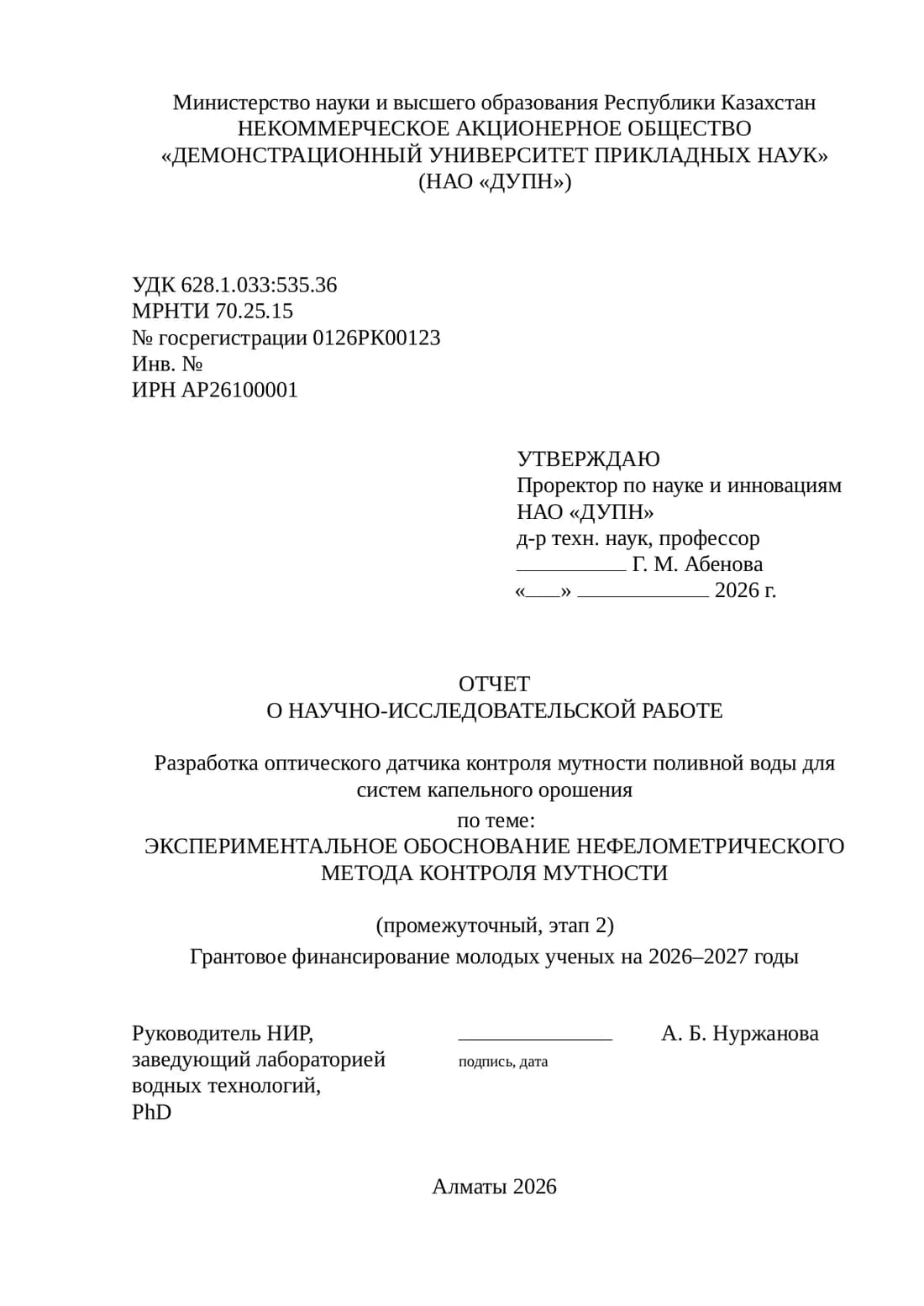
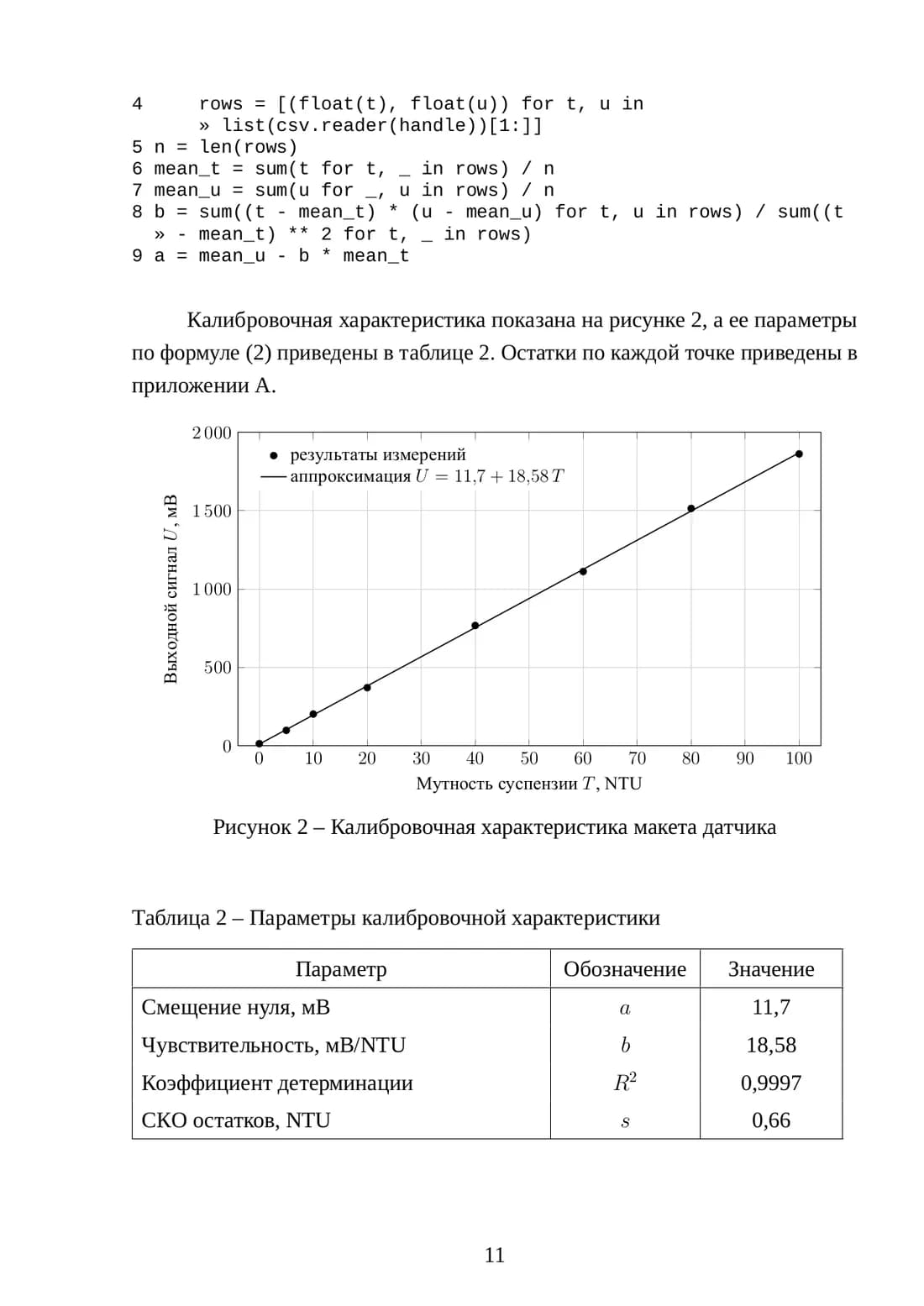
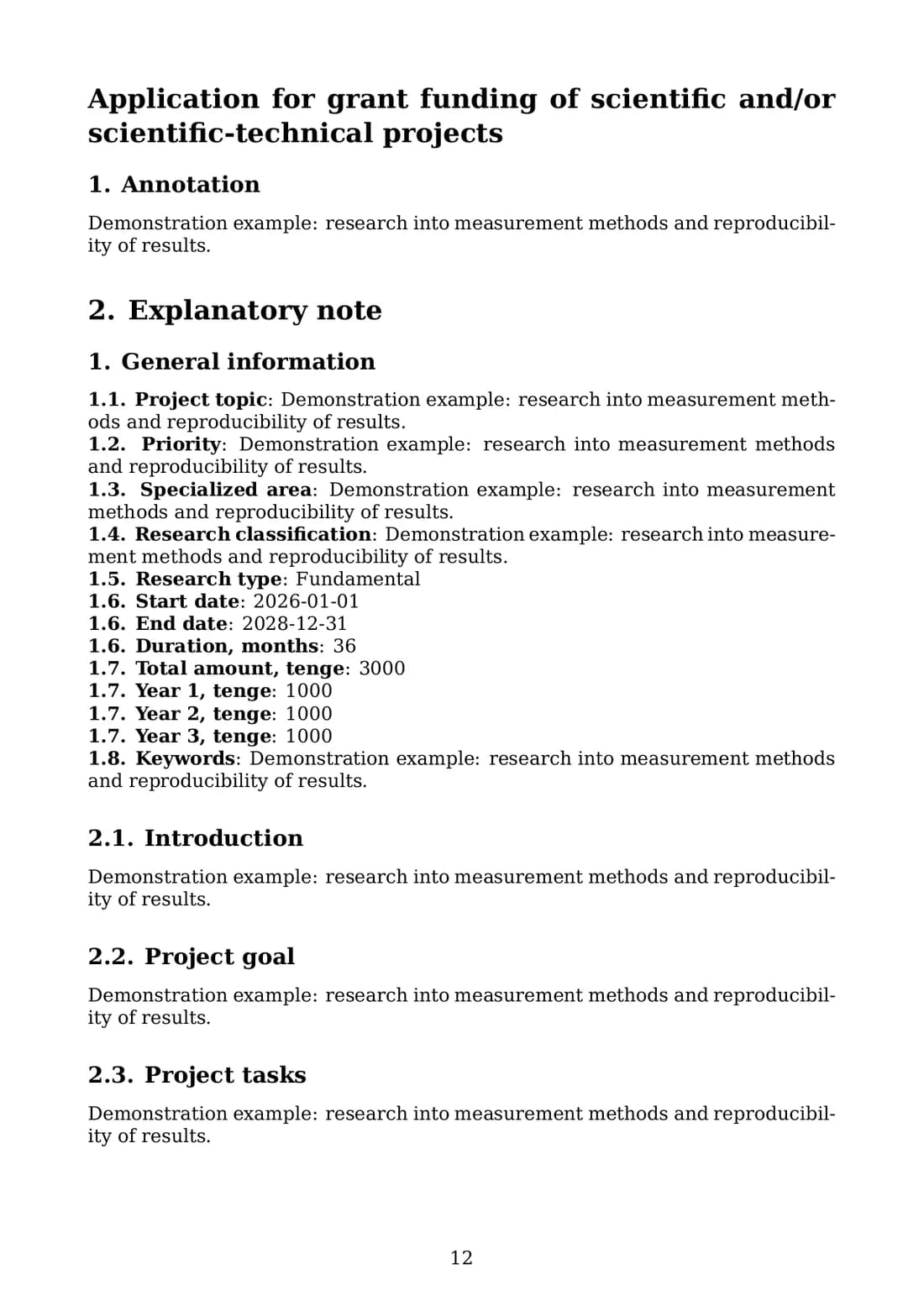
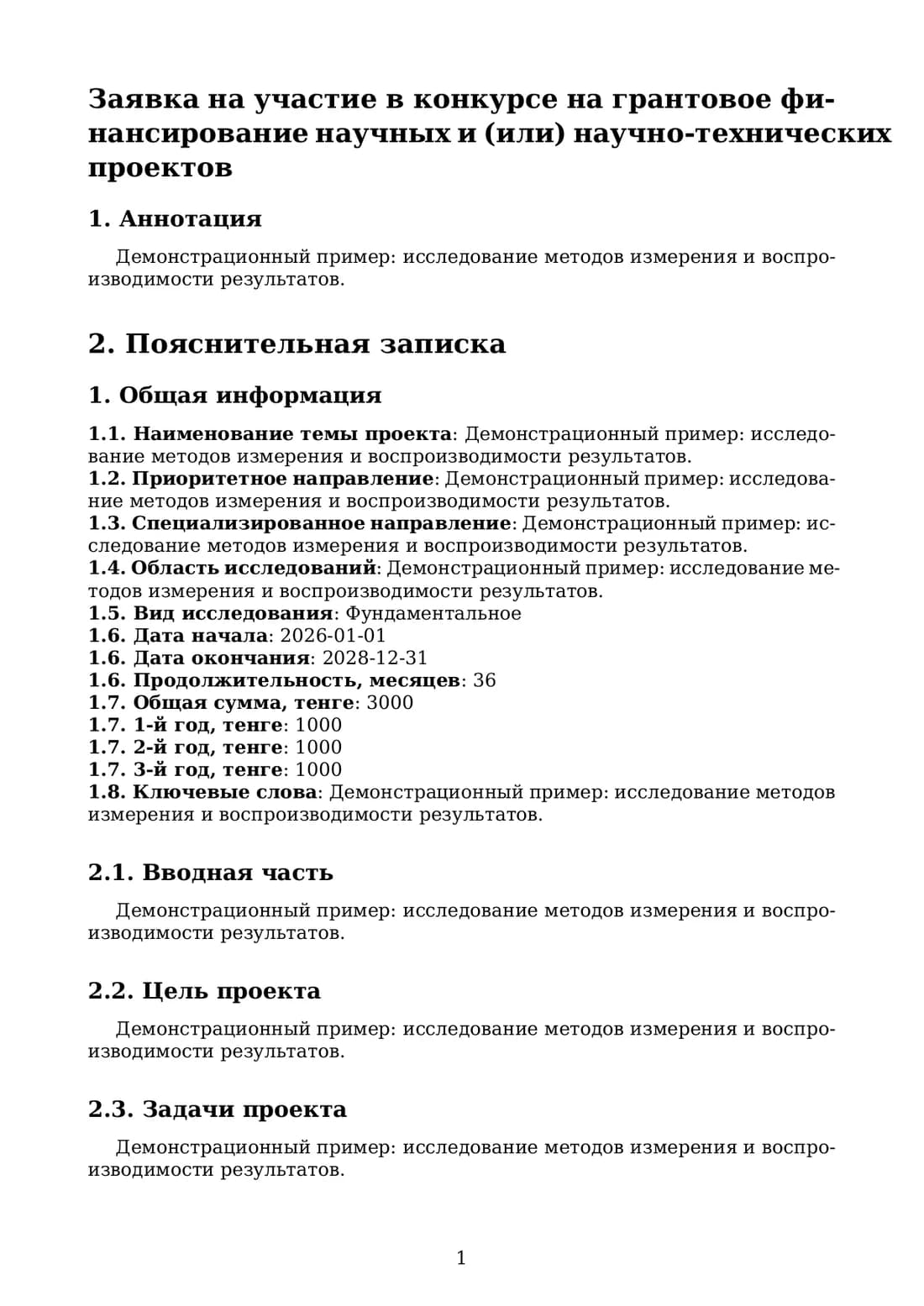
Two pages as their packages render them. Each number marks something the author did not have to do by hand.
Real checks from today's packages. Where a check comes from the authority it says where; where it is the platform's own, it says that.
| Check | What it catches | Basis |
|---|---|---|
| NCSTE grant funding, 2026-2028 | ||
| GF.WORD_LIMIT | An annotation or explanatory-note item over its word limit | Required by the call, Annex 1 |
| GF.CONCEPT_WORD_LIMIT | Items 2.1 to 2.3 over 750 words together, in any language | Required by the call, Annex 1, item 2 |
| GF.LANGUAGE_CHOICE | No choice yet between Kazakh and Russian for the main text | Required by the call, §4(2) and §5(1) |
| GF.FORM_STRUCTURE | An official table whose fixed header was changed | Form integrity, Annex 1, Tables 1-9 |
| NCSTE commercialization, 2026-2028 | ||
| BUDGET.TOTAL_MISMATCH | A cost estimate that does not add up to the requested grant | Arithmetic of the estimate |
| Research report, GOST 7.32-2017 | ||
| REPORT.KEYWORDS.COUNT | Fewer than 5 or more than 15 keywords | Required by GOST 7.32-2017, 5.3.2.1 |
| Invention patent application | ||
| PATENT.TITLE.KAZAKH | An invention title missing in Kazakh | Required by the examination rules, order No. 1349, p. 6 |
| PATENT.CLAIMS.SENTENCE_END | A claim that does not end with a full stop | Required by order No. 1349, p. 24(4) |
| Every package | ||
| REFERENCE.DANGLING_CITATION | A citation that points to no source | Platform integrity |
| TRANSLATION.STALE | A translation older than the text it translates | Platform integrity |
Researchers, the institutions around them and the bodies that set the rules use the same package for different jobs.
Researchers, PhD students, supervisors and project leads
“How do I produce the correct document?”
Open the document and the official structure is already there. Spend your effort on the proposal, not on reproducing the form.
Research offices, doctoral schools and grant managers
“Did everyone use the current form, and is everything complete?”
Checks prove the deterministic part before a document reaches you, so your review goes where judgment is needed.
Universities and research institutes
“Hundreds of authors, and a different Template_final.docx in every department.”
Decide which package your institution uses for each regime. Every author then starts from the same executable definition, in your own workspaces.
Competition issuers such as NCSTE
“Applications arrive with the same avoidable defects.”
Publish a call together with its executable package. Every university and researcher then prepares against one interpretation and fixes deterministic defects before filing.
The Ministry of Science and Higher Education and its committees
“The same rule, interpreted separately by every university.”
Turn a rule into one verified package and distribute it nationally. Every institution runs the same machine-readable interpretation, in its own workspace, with its own data.
Kazakh, Russian and English versions live together. Facts are entered once; each language writes its own text.
| Қазақша | Русский | English | |
|---|---|---|---|
| Annotation | Required | Required | Required |
| Explanatory note | Kazakh or Russian | Kazakh or Russian | Required |
| Requested financing | Kazakh or Russian | Kazakh or Russian | Required |
Normaline never machine-translates your text. People record how each version was translated and whether it is current.
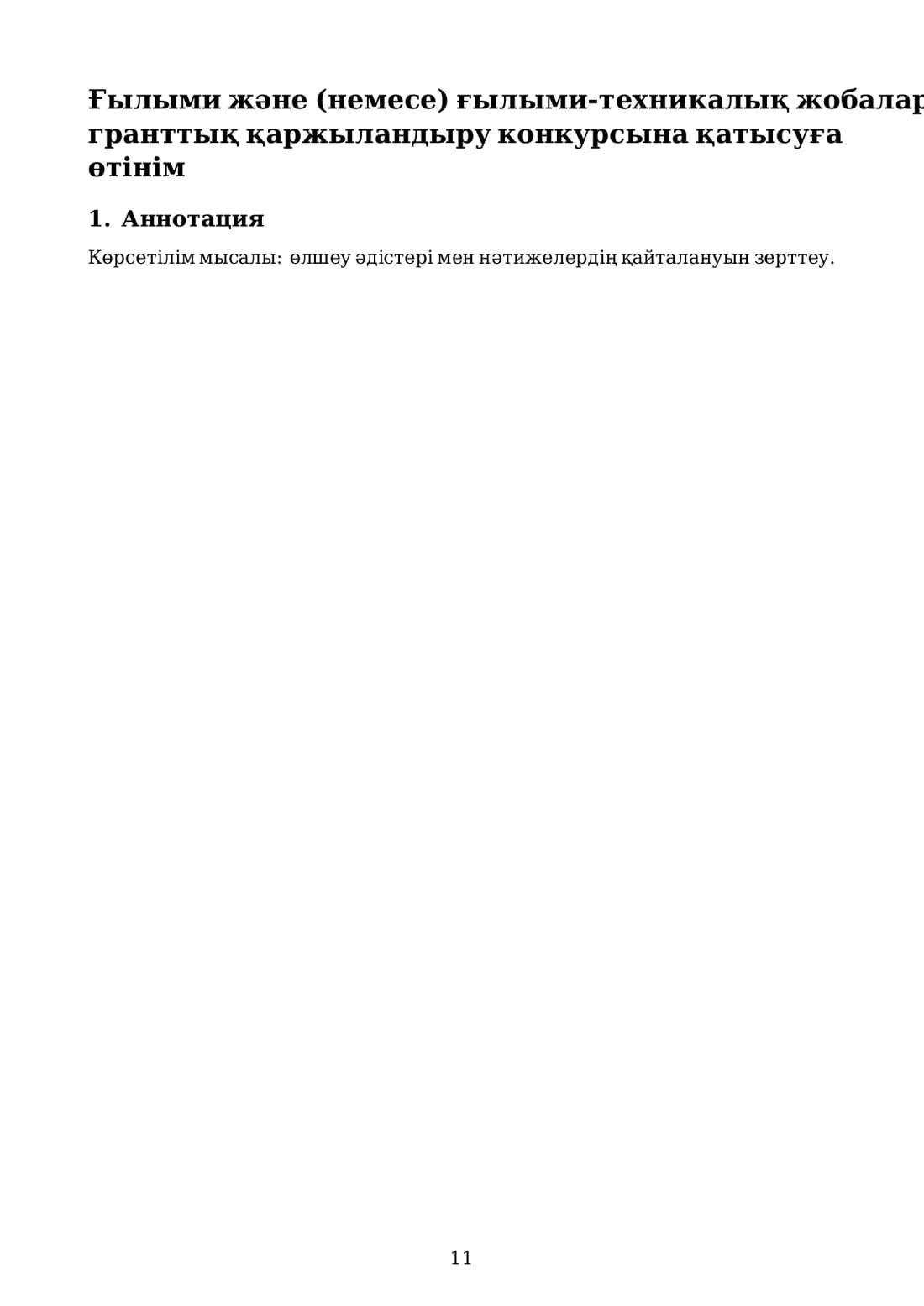
Each package implements a real document regime. The platform stays the same; only the package changes.
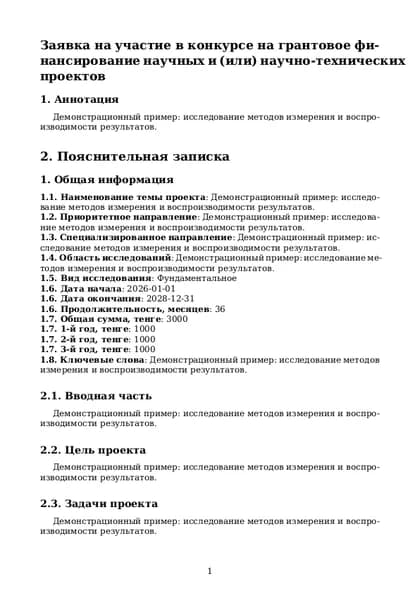
NCSTE GF
KK, RU, EN
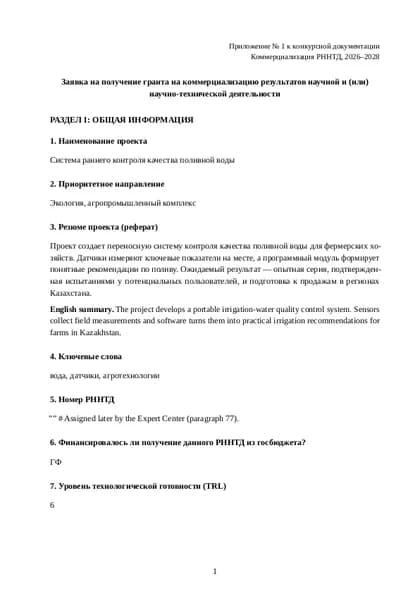
NCSTE
RU, KK
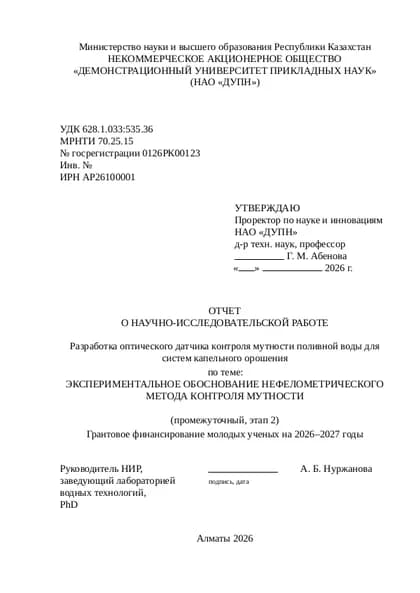
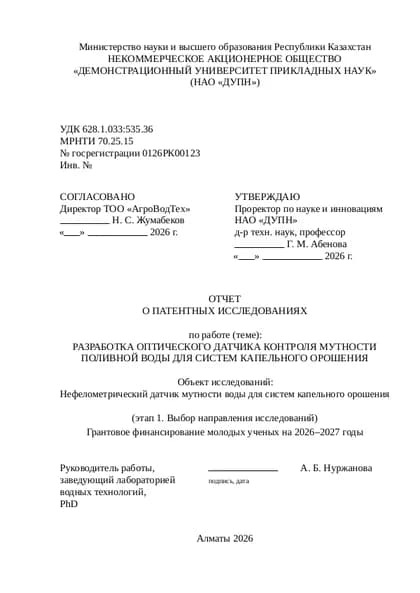
ГОСТ 7.32-2017
RU
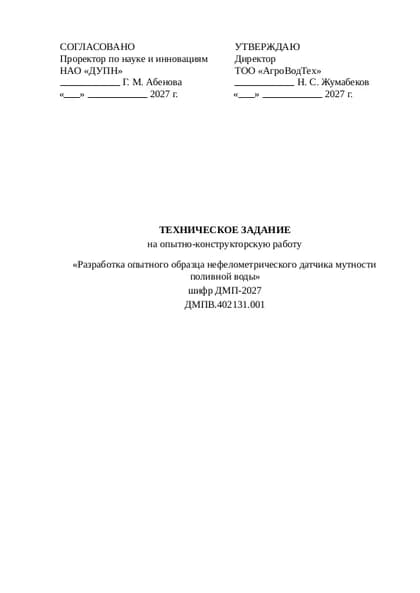
ГОСТ 15.016-2016
RU
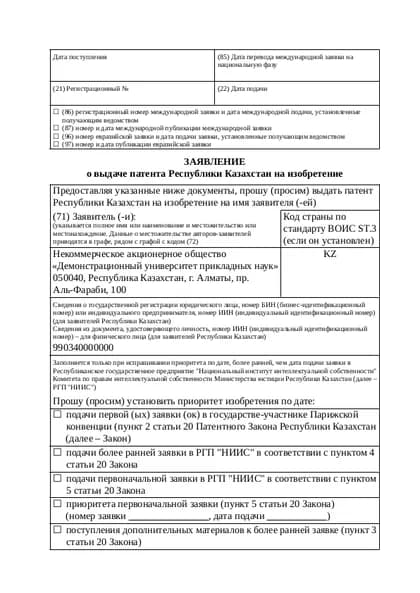
Patent Law of the RK
RU
СТ РК ГОСТ Р 15.011
RU
Universities can publish their own regimes the same way. A doctoral dissertation package is in preparation.
Rendered by the package's own LaTeX renderer. This is the document as the regime prints it.
For colleagues and institutions that still edit in Word: real tables, equations, lists and footnotes. Pagination may differ from the PDF.
Text, tables, references, assets and every language version, with a checksum manifest. No template code inside; your work stays yours.
No. Normaline prepares the documents. Applications are still filed in NCSTE's own system, which Normaline does not connect to.
No. Checks report defects that can be proved from the document and its package. Merit, eligibility and budget justification stay with people.
The package changes, not every author's copy of a form. Each document records the package version it was written under.
Yes. A package can be private to your workspaces: a dissertation, an internal report or any regime you define. A doctoral dissertation package is in preparation.
Yes. Every document exports to an editable DOCX with real tables, equations, lists and footnotes. The PDF stays the authoritative result.
No. Normaline runs no AI model and never translates your text. People write each language and record how each version was translated.
Yes. The semantic source exports text, tables, references, assets and every language version, with no template code inside.
Yes, from Word and LaTeX, as far as the source allows. The import report lists what came across, what was normalized and what could not be kept.
For researchers, for the institutions that support them, and for the bodies that set the rules.
Accounts are issued by invitation for now. Self-service sign-up opens later.